“Free” Books

Via Lifehacker, legal cost-free books under copyright from Wowio. This is a great idea, and I give it even odds for being the future of books. (Or at least, part of books’ future).

What is WOWIO?
WOWIO is a new kind of online bookstore that enables readers to download ebooks for free, using commercial sponsorships to compensate authors and publishers. Readers get free ebooks. Sponsors get a powerful new channel to communicate their message to precisely the people they want to reach. Publishers get a new means of distributing their books, expanding their readership, and monetizing their intellectual property.

Does WOWIO use any kind of digital rights management (DRM)?
Since anyone can defeat the most “sophisticated” DRM with the print screen button, we believe that technology-based DRM is essentially a fraud. Our approach takes the market incentive out of misbehaving, rewards people for doing the right thing, and tries to stay out of the way of honest users. To help keep everyone honest, however, readers must authenticate their identity and agree to a licensing agreement when they set up their account. Then, each ebook is serialized with the reader’s authenticated name and a unique serial number, as well as other less visible markers. WOWIO will immediately terminate the account of anyone caught illegally distributing ebooks, and will prosecute serious offenders.

Technorati Tags: , , , ,

The Onion Video is the New SNL

Growing up for the most part in the 1980’s, Saturday Night Live was the funniest regularly scheduled part of my week. It’s either gotten less funny over the years, or I’ve changed. Probably both.

One of the biggest problems SNL faces is that it must fill ninety minutes every week, although these days if you subtract out ads, music, and other filler/transitional material,  I expect it’s only thirty to forty minutes of actual comedy. Either way, a lot of SNL skits go on longer than necessary to deliver their comic payload. I expect this was actually true in the 1980’s as well, but I didn’t notice it so much.

Enter The Onion and its video content.  Freed from the confines of the television programming schedule, the Onion can make its online video clips just exactly as long as the writers want, and release them on their own schedule. In recent months, they’ve been batting in the high 800s. E.g., Diebold Accidentally Leaks Results of 2008 Election Early (on a serious note, see Ed Felten’s recent Sequoia discovery and followup); Army Holds Annual ‘Bring Your Daughter to War’ Day. Or any of them, really.


White House Press Secretary Spins Wife’s Tragic Death As A Positive


Army Holds Annual ‘Bring Your Daughter To War’ Day

My only complaint about The Onion video content is that they have only one sponsor at any given time, and they make you watch the same exact ad (both as a short pre-mercial and a longer post-mercial) every time you watch a video. The repetition isn’t effective and I can’t imagine it’s the best use of the Onion’s advertising revenue. I suggest at least rotation ads — or better yet, only forcing an ad on the viewer after every nth video.

Thanks to Steve and Flour for the key insight about clip-length.

Technorati Tags: ,

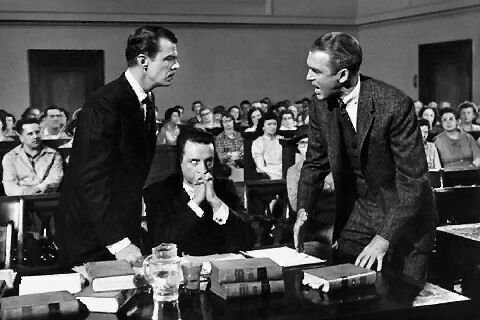
The Best Movie to Start at 11pm at the End of a Long Trial…

Anatomy of a Murder. David Denby put it best:

Otto Preminger’s “Anatomy of a Murder,” from 1959, is still the best courtroom drama ever made in this country, and, in its occasional forays out of the court, among the finest evocations of place—an Upper Peninsula Michigan resort area in the off-season, leafless, underpopulated, alcoholic, and forlorn. James Stewart, in one of his wonderful melancholy “late” performances, plays a former county prosecutor named Biegler, a lifelong bachelor who now spends his time with a non-practicing lawyer (Arthur O’Connell) and an unpaid secretary (Eve Arden), who sticks around for the wisecracks. The movie is leisurely, detailed, realistic, intensely companionable; you get a sense of how people exist at the margins of a profession without losing their dignity.

Although there are some distinctions between a murder defense in the 1950’s in the Upper Peninsula of Michigan and modern-day patent litigation, the essence of trial technique is really not all that different.  Highly recommended.

Prosecutor: Lieutenant Manion, wasn’t your action against Barney Quill much the same thing as your action against Miller or the Lieutenant you slapped at the cocktail party — all done in the heat of anger, with a willful, conscious desire to hurt or kill?

Defendant: I don’t remember my action against Quill.

Prosecutor: How long had you known your wife was stepping out with Quill?

Defendant: I never knew anything like that. I trust my wife.

Prosecutor: You just occasionally beat her up for the fun of it, I suppose?

Defense Counsel: There has been nothing established to permit a question like that. He keeps trying to insinuate without ever coming to the point. Let him ask the Lieutenant, did he ever beat his wife.

Judge: I will sustain the objection. Do you want to re-phrase your question, Mr. Dancer?

Prosecutor: No thank you, Your Honor. I’ve finished.

Technorati Tags: , ,

The Song of the Day is…

Liberation Dance from the curiously-difficult-to-find album Anthem for the New Nations (yes, that’s CDN$97.18!) by Dollar Brand.

Unfortunately, I can only share a taste (mp3, ogg).

How music this good could be out of print is beyond me.

Technorati Tags: , , , ,

Update: I added the Google embedded Mp3 player as an experiment and resampled the MP3. Apparently the Google MP3 player can only play files at 44.1 KHz correctly.

Doonesbury on Pandora

A sign of cultural permeation: both Doonesbury and my father have discovered Pandora.

Technorati Tags: ,

Success as a Parent

Success as a parent is when your two year old recognizes and demands, at various times, Joni Mitchell, Paul McCartney (particular tracks), They Might Be Giants, and the White Stripes. And when she knows how to operate her own portable CD player and navigate your cell phone photo library.

These are skills that the Class of 2026 is going to need.

Smooth Velouria Espresso

I just discovered the recently-opened Velouria Espresso in Jamaica Plain via this subscribers-only article in the Atlantic. Velouria marks the latest arrival in the single-origin coffee movement pioneered by George Howell. In a nutshell, the idea of single-origin coffee beans is that if beans are identified with a particular region (or even particular grower), the farmers will have more incentive to distinguish themselves. Ultimately, coffee beans will be known like fine wines, and the best growers will earn premium prices (thus bringing even more money to underdeveloped areas than coffee sold as fair-trade). Flatblack Coffee Company, near my office, operates under similar principles. More details in this episode of On Point with George Howell.

Velouria distinguishes itself with its focus on brewed coffee rather than espresso (although they have plenty of that as well). The shop features the “Clover” coffee machine (”Bring out the subtle nuances of all of your coffees through complete, independent control of all of the important brew parameters: grind size, dose, water temperature, and contact time.”)

I got a cappucino and a single-origin Kenyan coffee made with the Clover Machine. (Actually, two distinct single-origin Kenyan coffees, which Steve surreptitiously swapped on me while I wasn’t looking). They were all excellent.

My cappucino started with a little foam heart in the crema:

P1040782

Amazingly, even when it was finished, the heart was still faintly visible:

P1040784

Steve enjoyed his espresso as well:

P1040783

Velouria has no website that I could find. it’s at 389 Centre Street, Jamaica Plain, MA 02131. Beware the Yelp page as it has inaccurate hours information — just call them at (617) 522-2400 if you’re wondering if they’re open.

Now if we could only get a place like this in one of the vacant storefronts in Roslindale

Technorati Tags: , , , , ,

Multitasking and Classical Music

Two recent print-media articles begging to be linked:

First, the Autumn of the Multitaskers in this month’s Atlantic. Despite the age-of-Internet theme, the full article is only available to subscribers. The thesis is one I’ve seen before (e.g., in GTD). Namely: although we might feel like we’re accomplishing more when multitasking, we actually end up less productive, and eventually we’ll lose our minds if we continue to overload our sense. The writer takes the idea further than I’ve seen before, incorporating several astonishing indicators from the zeitgeist, including this NSFW quote from Jennifer Connelly that I won’t reprint, and several foreign policy and domestic political examples of how multitasking is failing our culture and our country.

There is a generational divide at work here. Most in previous generations (say, people over 40) didn’t come online until the Internet was nearly full-blown with spam, entertainment news, popups, advertising, streaming stock quotes, rich media services, IM, Facebook, Flash, etc.. These people generally deal poorly with information and sensory overflow because they had no incremental introduction.

The younger generations (people under 25) don’t remember the world before the Internet and multipurpose portable devices, and thus think it entirely normal to watch TV, surf the web with a few open windows, talk on the phone (perhaps VoIP), and IM at the same time. At least. And they’re bored if they don’t have at least have three or four tasks going simultaneously. This isn’t to say that these gen-Yers are actually doing a good job at it — I find myself often answering computer-related questions from my younger siblings because they can’t actually read a focused page or two of dense text on the computer (e.g., a readme file) in one sitting — but rather that they don’t experience the flow as psychologically overwhelming.

That leaves my (in between) generation, generally people born in the 1970’s. Those of us who grew up with early low-bandwidth wide area networks — I started on BITNET, USENET, and BBS’s in the early- to mid-1980’s — have better mechanisms for coping and prioritizing. Perhaps because our multitasking options were relatively limited, we haven’t leaped on the bandwagon to the same extent as others. I personally don’t mind two simultaneous tasks — e.g., perusing RSS headlines and listening to MP3s — but more than that doesn’t interest me. (I don’t count it as “multitasking” in the same sense where one of the tasks is just waiting, e.g., for code to compile or a large upgrade to download).

Please feel free to destroy my broad generalizations here in the comments.

While we’re on the subject of multitasking, I fall into the “subtle exception” category described in Getting Things Done:

The Multitasking Exception

There’s a subtle exception to the one-item-at-a-time rule. Some personality types really need to shift their focus away from some task for at least a minute in order to make a decision about it. When I see this going on with someone, I let him take two or sometimes three things out at once as he’s processing. It’s then easier and faster for him to make a choice about the action required.

I find this trick particularly helpful in getting unstuck. Frequently, when drafting briefs, I’ve rewritten a sentence eight or nine times and it still doesn’t seem to get across the necessary idea efficiently and without making the reader do any hard work. Switching to another (usually simpler) task, if only for one or two minutes, is often enough to come back and do it right in one swoop. In this situation (and probably only in this situation), multitasking actually saves me time.

Second, the Well Tempered Web (by Alex Ross, music critic with a blog) in this week’s New Yorker. This one is more naturally available in complete form online. Ross manages to weave together Wagner, Snakes on a Plane, the Long Tail, and Rick Rubin. Worth reading. (And while you’re at it, check out Adam Gopnik’s piece on abridgments, which unfortunately is not available online.)

Lest you all think all I read is the New Yorker and the Atlantic: it’s not true. I’m just not at liberty to disclose my other sources at this time.

Opened Pandora

Via Eric Goldman’s recent recommendation, I decided to give Pandora another shot. The short version: Pandora is an intelligent predictive personalized Internet radio service with an arguably sustainable and protectable business model. And by “intelligent,” I mean there are real human brains at work. As Eric explains:

Pandora’s main competitive differentiator is its “Music Genome Project.” 50 trained musicians with at least a college degree in music (called “music analysts”) listen to songs all day long and rate each song on 400 different musical attributes. See the 2005 WSJ article discussing them. By profiling songs this way, the system can predict that a person who likes an artist’s song might like other songs with similar musical attributes. From listening to Pandora for many, many hours, IMO the system isn’t perfect, but it does a pretty good job, and it has definitely hooked me on music that I wouldn’t have listened to otherwise.

They have apparently cataloged approximately half a million songs and the database continues to grow apace. There is also a collaborative-filtering aspect, similar to Netflix and Amazon. I suspect this hybrid between the “wisdom of crowds” and the “wisdom of experts” will be the future of most large content projects (including wikipedia).

My first few hours have returned excellent results. I created a for-working “station” called, lazily, “The Bad Plus Radio” (described as “Avant garde and angular funk/jazz, but not so dissonant that you can’t do mind-taxing work while listening”). You are welcome to listen as well. (See also my Pandora Profile.) The “artist seeds” for the channel include the following:

  • The Bad Plus (of course)
  • Bill Frisell
  • John McLaughlin
  • Medeski Martin & Wood
  • Thievery Corporation
  • Bred Mehldau
  • Oliver Nelson
  • Ornette Coleman
  • Keith Jarrett

Pandora has played several tracks by these artists, but is increasingly mixing in other artists that match up on some axis of preference. I’ve thumbed-up and thumbed-down several tracks from beyond the “seed” set (and will continue to do so), thus driving the predictive engine. I look forward to creating some entirely different channels and publishing the URLs here.

Although supposedly the “free” version is ad-supported, I haven’t heard any ads yet. Maybe that is still to come. In any case, it is probably worth the $36/year subscription cost.

Beyond the specific content I’m enjoying here, it is nice to see a Web 2.0 (or pick your favorite version) business model that doesn’t require a leap of faith to see how it can work.

Of course, they have a Facebook app as well.

Paul Graham on College

Great essay from Paul Graham about why college prestige doesn’t matter. (I wish I had both the time and ability to churn out his volume of high-quality writing.) My favorite parts were the following two footnotes:

…No one ever measures recruiters by the later performance of people they turn down.[2]…

[2] Actually, someone did, once. Mitch Kapor’s wife Freada was in charge of HR at Lotus in the early years. (As he is at pains to point out, they did not become romantically involved till afterward.) At one point they worried Lotus was losing its startup edge and turning into a big company. So as an experiment she sent their recruiters the resumes of the first 40 employees, with identifying details changed. These were the people who had made Lotus into the star it was. Not one got an interview.

…Obviously you can’t prove this in the case of a single individual, but you can tell from aggregate evidence: you can’t, without asking them, distinguish people who went to one school from those who went to another three times as far down the US News list. [3]…

[3] The US News list? Surely no one trusts that. Even if the statistics they consider are useful, how do they decide on the relative weights? The reason the US News list is meaningful is precisely because they are so intellectually dishonest in that respect. There is no external source they can use to calibrate the weighting of the statistics they use; if there were, we could just use that instead. What they must do is adjust the weights till the top schools are the usual suspects in about the right order. So in effect what the US News list tells us is what the editors think the top schools are, which is probably not far from the conventional wisdom on the matter. The amusing thing is, because some schools work hard to game the system, the editors will have to keep tweaking their algorithm to get the rankings they want.

As an alum of a fairly prestigious institution, I think I endorse Graham’s conclusions.