Filed under The Web by adam | July 26, 2008 | 2 comments
I’ve used the TLA EOM occasionally, but never considered the full scope of its utility. Lifehacker just made me a full convert:
EOM means much more than End of Message. It means “good use of time.” It means “concise.” It means “clarity.” But GUOTCC doesn’t have the same ring as EOM, so let’s stick with it. Here are eight great reasons for you to adopt EOM while crafting your email messages.
(1) EOM saves your recipient’s time.—Don’t you value your time? Isn’t it nice when others value your time too? By keeping your subject line short and using EOM you are showing the people you send to you value their time. They’ll thank you for it (when they know what it means).
…
(8) EOM guarantees 100% readership—We’ve all had the frustrating experience of waiting on someone to read our important email and respond. Sometimes we wait a long time and follow up to find out they haven’t even read the message at all. Perhaps the most powerful advantage of EOM is 100% readership. Why? Because your entire message is in the subject line. Your message becomes impossible to ignore because it comes in front and center—no need to double click.
In a job where I receive between 300-1000 emails on most weekdays, every little bit helps. The main drawback of excessive EOM’ing may be that it breaks threading for some mail readers, and may be incompatible with other email conventions.
Technorati Tags: Email, EOM, Lifehacker, Productivity
Filed under The Law, The Web by adam | April 21, 2008 | 5 comments
I reluctantly include Slashdot in my Google Reader subscriptions. I’ve yet to find another source with the same breadth of news coverage that approximately matches my personal and professional interests. The problem is that I’m increasingly annoyed by the editorial slant. The comments have always been hit-or-miss — mostly miss — but as I’ve gained expertise over the past six or seven years (particularly in legal topics), I’ve noticed that the article summaries themselves are invariably written by someone who has no idea what they are talking about.
So I ask the blogosphere: what’s a good Slashdot substitute? I’m looking for something with a good mix of breaking science, technology, Internet, law, and free-speech type stories, but without everything that makes Slashdot irritating.
Technorati Tags: Slashdot
Filed under Copyright, Culture, The Web by adam | March 29, 2008 | 0 comments
Via Lifehacker, legal cost-free books under copyright from Wowio. This is a great idea, and I give it even odds for being the future of books. (Or at least, part of books’ future).
What is WOWIO?
WOWIO is a new kind of online bookstore that enables readers to download ebooks for free, using commercial sponsorships to compensate authors and publishers. Readers get free ebooks. Sponsors get a powerful new channel to communicate their message to precisely the people they want to reach. Publishers get a new means of distributing their books, expanding their readership, and monetizing their intellectual property.
Does WOWIO use any kind of digital rights management (DRM)?
Since anyone can defeat the most “sophisticated” DRM with the print screen button, we believe that technology-based DRM is essentially a fraud. Our approach takes the market incentive out of misbehaving, rewards people for doing the right thing, and tries to stay out of the way of honest users. To help keep everyone honest, however, readers must authenticate their identity and agree to a licensing agreement when they set up their account. Then, each ebook is serialized with the reader’s authenticated name and a unique serial number, as well as other less visible markers. WOWIO will immediately terminate the account of anyone caught illegally distributing ebooks, and will prosecute serious offenders.
Technorati Tags: Wowio, Books, DRM, Digital Rights Management, Copyright
Filed under Culture, Humor, The Web by adam | March 21, 2008 | 4 comments
Growing up for the most part in the 1980’s, Saturday Night Live was the funniest regularly scheduled part of my week. It’s either gotten less funny over the years, or I’ve changed. Probably both.
One of the biggest problems SNL faces is that it must fill ninety minutes every week, although these days if you subtract out ads, music, and other filler/transitional material, I expect it’s only thirty to forty minutes of actual comedy. Either way, a lot of SNL skits go on longer than necessary to deliver their comic payload. I expect this was actually true in the 1980’s as well, but I didn’t notice it so much.
Enter The Onion and its video content. Freed from the confines of the television programming schedule, the Onion can make its online video clips just exactly as long as the writers want, and release them on their own schedule. In recent months, they’ve been batting in the high 800s. E.g., Diebold Accidentally Leaks Results of 2008 Election Early (on a serious note, see Ed Felten’s recent Sequoia discovery and followup); Army Holds Annual ‘Bring Your Daughter to War’ Day. Or any of them, really.
White House Press Secretary Spins Wife’s Tragic Death As A Positive
Army Holds Annual ‘Bring Your Daughter To War’ Day
My only complaint about The Onion video content is that they have only one sponsor at any given time, and they make you watch the same exact ad (both as a short pre-mercial and a longer post-mercial) every time you watch a video. The repetition isn’t effective and I can’t imagine it’s the best use of the Onion’s advertising revenue. I suggest at least rotation ads — or better yet, only forcing an ad on the viewer after every nth video.
Thanks to Steve and Flour for the key insight about clip-length.
Technorati Tags: The Onion, Saturday Night Live
Filed under Technology, The Law, The Web by adam | February 3, 2008 | 0 comments
Filed under Kids, The Web by adam | December 23, 2007 | 3 comments

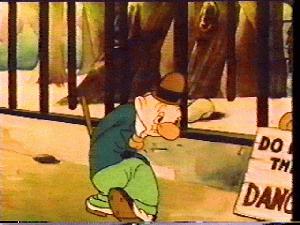
One great thing about kids — especially kids who have not been overexposed to TV media — is how easily entertained they are. We recently showed Esther some Looney Tunes cartoons from the 1940’s (on a real TV, no less!) and she couldn’t stop laughing. It is refreshing to see someone spellbound by animated content that didn’t require a rendering farm to create. I’m sure she’ll be jaded soon enough, but we’re trying to drag it out as long as possible by providing only very occasional small doses.
This piece on the end of reading as a cultural activity is chock full of interesting statistics. This excerpt, in particular, is relevant here:
In August, scientists at the University of Washington revealed that babies aged between eight and sixteen months know on average six to eight fewer words for every hour of baby DVDs and videos they watch daily. A 2005 study in Northern California found that a television in the bedroom lowered the standardized-test scores of third graders. And the conflict continues throughout a child’s development. In 2001, after analyzing data on more than a million students around the world, the researcher Micha Razel found “little room for doubt” that television worsened performance in reading, science, and math. The relationship wasn’t a straight line but “an inverted check mark”: a small amount of television seemed to benefit children; more hurt. For nine-year-olds, the optimum was two hours a day; for seventeen-year-olds, half an hour. Razel guessed that the younger children were watching educational shows, and, indeed, researchers have shown that a five-year-old boy who watches “Sesame Street” is likely to have higher grades even in high school. Razel noted, however, that fifty-five per cent of students were exceeding their optimal viewing time by three hours a day, thereby lowering their academic achievement by roughly one grade level.
It certainly doesn’t surprise me that television–even educational TV–is generally not good for kids. The “inverted check mark” bit was a surprise, though. Who would guess that two hours a day is optimal for the nine-year-old brain?
On a related note, Kiddie Records Weekly (recommended by about.com here) is an astonishingly extensive source of free children’s books in MP3 format. It’s also an excellent example of the increasing relevance of bittorent in enabling wide economical distribution of legitimate content. The content is primarily (exclusively?) digitized vinyl records from the 1930’s and 1940’s. Fortunately, Alice in Wonderland gets no worse with age.
To complete the nostalgia circuit, who can forget “loaf of bread, a container of milk, and a stick of butter” (via sketchelement, quite a while ago):
These are good times to be a kid. Or maybe just to be a parent.
Technorati Tags: Looney Tunes, Alice in Wonderland, Reading, TV, Cartoons, Sesame Street, Bittorrent
Filed under Humor, The Web by adam | December 17, 2007 | 0 comments
Via Steve Via Ze: Gabe and Max’s Internet Thing. “Very funny.”
A sequel. “Also funny”:
Filed under Privacy, Social Networking, The Law, The Web by adam | December 10, 2007 | 0 comments
James provides an overview of some of the legal privacy problems with Facebook Beacon: first, in law school essay form, then, as a sitcom dialogue complete with laugh track. I recommend the latter, unless you’re in law school or a practicing lawyer.
Technorati Tags: Facebook, Beacon, Privacy, James Grimmelmann
Filed under Social Networking, Technology, The Web by adam | November 25, 2007 | 0 comments
timbl’s blog may have the highest signal-to-noise ratio on the web. Not a whole lot of signal, but zero noise.
This piece on the “graph” puts the development of social networking services in solid historical perspective. It’s not great propaganda, but covers all the key conclusions. In particular:
In the long term vision, thinking in terms of the graph rather than the web is critical to us making best use of the mobile web, the zoo of wildy differing devices which will give us access to the system. Then, when I book a flight it is the flight that interests me. Not the flight page on the travel site, or the flight page on the airline site, but the URI (issued by the airlines) of the flight itself. That’s what I will bookmark. And whichever device I use to look up the bookmark, phone or office wall, it will access a situation-appropriate view of an integration of everything I know about that flight from different sources. The task of booking and taking the flight will involve many interactions. And all throughout them, that task and the flight will be primary things in my awareness, the websites involved will be secondary things, and the network and the devices tertiary.
Technorati Tags: timbl, Tim Berners-Lee, FOAF, social networking, Facebook
Filed under Kids, Life, Technology, The Web by adam | October 28, 2007 | 4 comments
My daughters are perhaps among the first who will grow up seeing much more YouTube than POTV (my newly coined acronym, “Plain Old TV.”) Esther, now 2½, has still never seen anything on a television (recorded, broadcast, or cable). (Havi, a week old today, may not have seen anything at all at this point.)
In addition to frequently watching videos from her own blog, Esther loves YouTube. Her most requested videos are embedded below, thanks to the excellent recently-installed Viper’s Video Quicktags.
Thus Esther may never know anything but on-demand and user-generated culture. At least those will be her basic assumptions about how it’s supposed to work. It’s possible that this next generation will spell the end of network-scheduled and traditional advertising-interrupted media. I can never understand why anyone would bother to arrange their schedule to watch a show on TV and sit through commercials when they can rent it from Netflix or buy it from Amazon or iTunes and watch it when and how they want — and I grew up, to some extent, with the old TV model. Esther can barely wait for whichever video she wants now. I can’t see her putting up with content on someone else’s schedule as she grows up.
Now the videos, as promised (both strong indicators that Esther adheres to the Long Tail theory):
Actually, it turns out I didn’t coin POTV. It’s already defined here.
Technorati Tags: Culture, Kids, YouTube, UGC